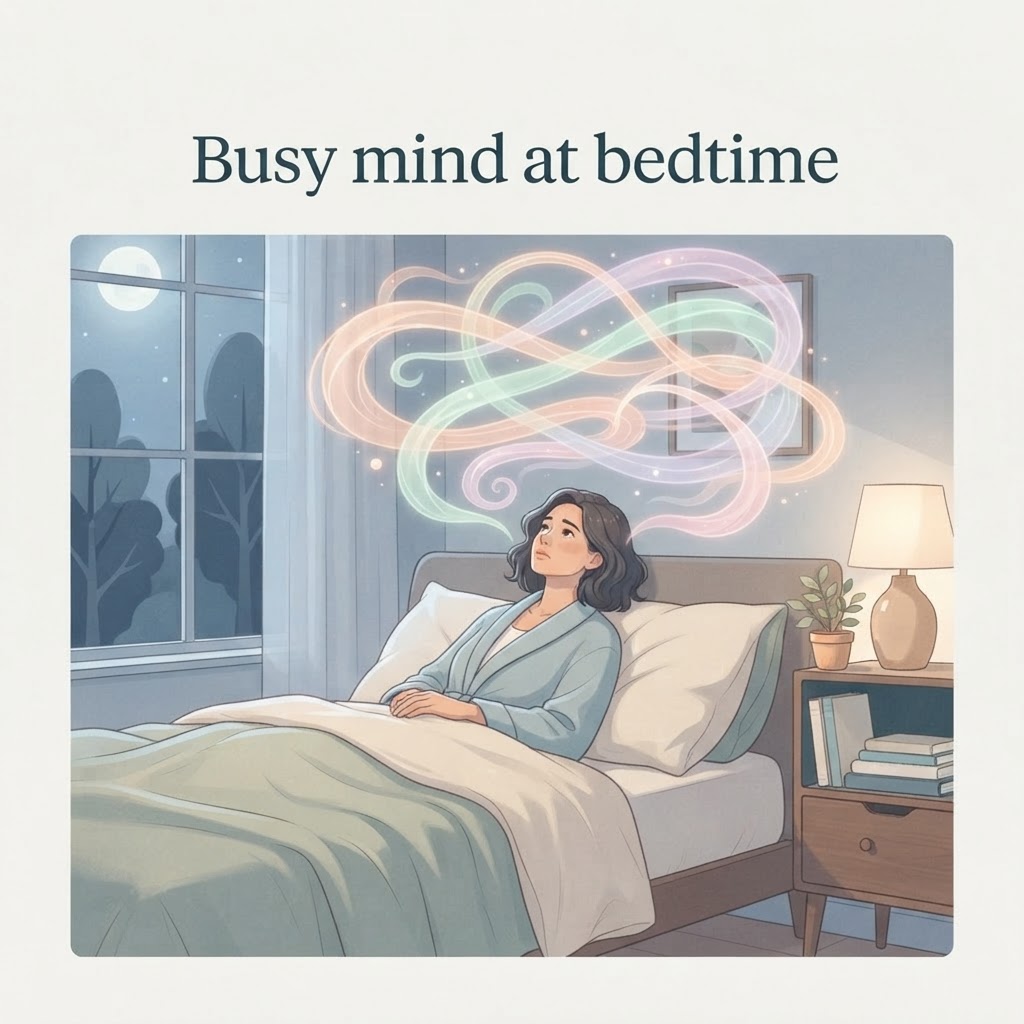
My mind won't switch off
The moment the lights go out, your brain starts replaying and planning.
Educational information — not medical advice. Talk to your care team about what's right for you.
Overview
Common Causes
- An incomplete transition from 'doing' to 'being' — no wind-down buffer between work and bed.
- Chronic stress that keeps the sympathetic nervous system mildly activated around the clock.
- Late-day stimulants, intense exercise, or emotionally charged media close to bedtime.
- Perfectionism and mental rehearsal — the brain trying to 'solve' tomorrow before it arrives.
- Conditioned mental arousal — the bed itself has become a cue for thinking rather than sleeping.
What You May Be Experiencing
- A flood of thoughts the moment you lie down, even when exhausted.
- Mental rehearsal of conversations, tasks, or 'what ifs' that you can't switch off.
- Feeling physically tired but mentally wired.
- Frustration that the harder you try to stop thinking, the louder the thoughts become.
- Relief only when you're so exhausted you can't stay awake — never from a calm drift into sleep.
Dr. Morse's Approach
Treatment Options
Scheduled 'worry time' earlier in the evening, brain-dump journaling, and CBT-I cognitive restructuring.
A protected wind-down hour, removing work and screens from the bedroom, and a predictable pre-sleep sequence.
Short-term support for anxiety or insomnia when behavioral strategies alone are insufficient — under clinical guidance.
Your Night-time Routine
A practical, step-by-step wind-down built around this concern's specific drivers. Follow it consistently for two to three weeks — rhythm, not perfection, is what resets sleep.
- 17:00 PM
Scheduled worry time — write down every concern, decision, and to-do in a notebook, then close it.
- 28:30 PM
Shift to low-arousal activities: reading, gentle stretching, or a warm bath — nothing goal-oriented.
- 39:00 PM
Screens off; warm, dim light only. If a thought surfaces, note it on a bedside pad and return to your breath.
- 49:20 PM
Slow breathing (4-7-8 or box breathing) for five minutes to downshift the nervous system.
- 59:30 PM
Lights out. If thoughts persist after 20 minutes, leave the bed, do something calm in dim light, and return only when sleepy.
Take this guide home
A printable PDF of this concern's full overview, routine, and treatment options.
Related Articles


When to Seek Help
Educational — Not Medical Advice
This content is provided for general educational purposes only and does not constitute medical advice, diagnosis, or treatment. It is not a substitute for consultation with a qualified healthcare professional. Submitting a question or receiving a reply does not establish a doctor-patient relationship. Always seek the advice of your physician or other qualified health provider with any questions about a medical condition, and discuss any changes to your care with your own care team.
Ready for personalized guidance?
Dr. Morse offers one-on-one and group coaching to help you move from understanding your sleep concern to changing it. Share what you're experiencing and she'll be in touch.
Request a Coaching Consultation